Exclude category trees from translations
If you have category trees in your Akeneo instance that should not be translated, you can exclude entire category trees from the translation process. This is useful when you have category trees for internal use, archived products, or other purposes where translations are not needed.
How it works
When you ignore a category tree, the TranslatorApp will skip:
- The root category itself
- All child categories within that tree (at any level)
This means no category labels from ignored trees will be translated, reducing unnecessary translation costs and keeping your translation tasks focused on relevant content.
Setting up category tree filters
Navigate to the settings area within the TranslatorApp and choose "Filter category trees".
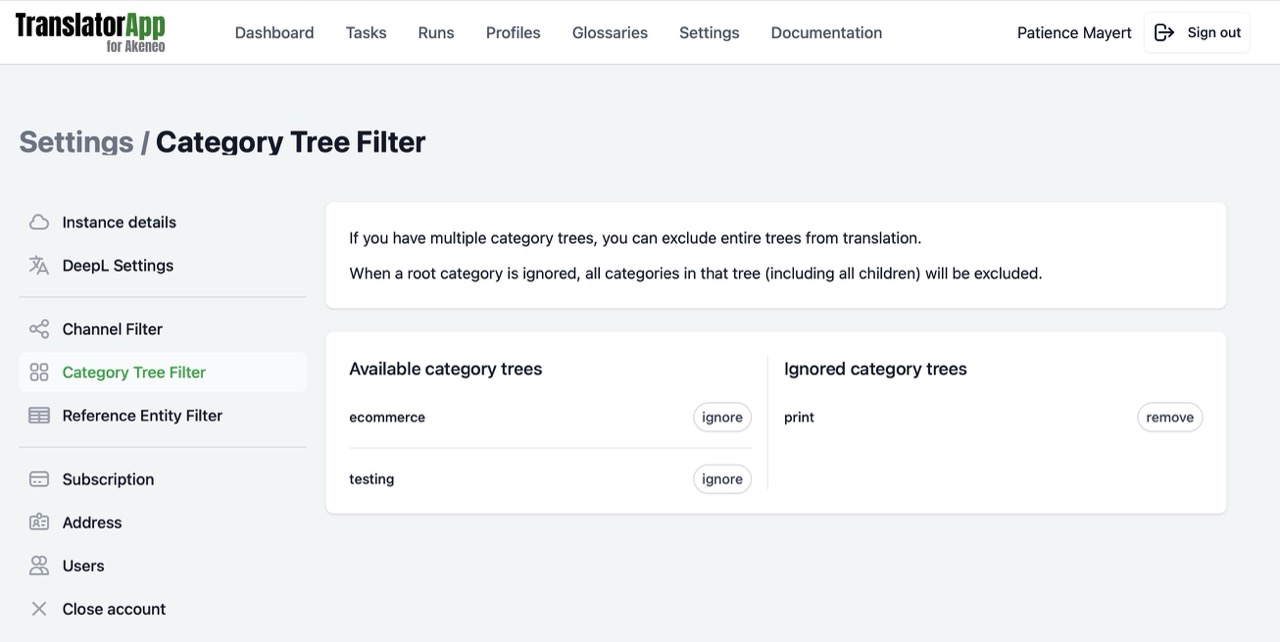
On the left side, you will see a list of all root categories (category trees) available in your connected Akeneo instance. Click "ignore" next to any category tree you want to exclude from translations.
Ignored category trees appear on the right side. You can remove them from the ignore list at any time by clicking the remove button.
When filters are applied
The category tree filter affects all new category label translation tasks. When you run a "Translate Category Labels" task:
- The TranslatorApp fetches only categories from non-ignored trees
- Categories in ignored trees are never retrieved or processed
- This results in faster task execution and lower translation costs
Viewing ignored trees in task runs
When you view the details of a completed task run, you can see which category trees were ignored at the time the task was executed. This helps you understand exactly what was translated and what was excluded.
The "Ignored category trees" section appears in the run details when any trees were excluded during that particular run.
Common use cases
- Archive trees: Exclude category trees used for discontinued or archived products
- Internal trees: Skip category structures used for internal organization that don't need customer-facing translations
- Test trees: Prevent test or development category trees from being translated
- Regional trees: Exclude category trees specific to regions where only one language is used